


Connolly Law Office is Veteran-Owned and operated
Connolly Law Office is Veteran-Owned and operated

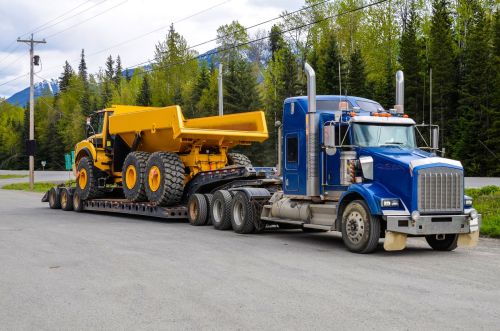
Illinois law provides several different permit mechanisms for carriers transporting oversize or overweight loads. Two permit types are frequently confused:
While both involve moving similar loads, they are governed by separate sections of the IDOT Policy Manual and Illinois Vehicle Code and carry different requirements and legal consequences. Applying the wrong legal standard can result in unnecessary citations.
A round-trip permit authorizes a carrier to move an oversize or overweight load from Point A to Point B and then return from Point B back to Point A. Instead of purchasing two separate permits, the carrier obtains one permit covering both directions.
Round-trip permits are governed by:
These provisions define what loads are eligible and what information the permit must contain.
The most important feature of the round-trip permit framework is that the outbound and return loads do not have to be identical. Both Section 554.1105 and 625 ILCS 5/15-302 permit a carrier to return with a “like” load.
The term “like” means similar in:
It does not require identical equipment. Minor differences such as:
Do not necessarily disqualify a load from qualifying as a “like” load if the machines remain functionally equivalent. For example, an excavator of one manufacturer and model class dropped off at a job site and a different variant of the same manufacturer and model class picked up on the return trip would generally qualify as a like object.
Under Section 554.1105, the permit description must include two of the following three identifiers:
Under 625 ILCS 5/15-302, the description must include make and model. These requirements help determine whether a return load qualifies as a “like” load rather than requiring exact identity.
A round-trip permit authorizes both legs of a move under a single permit. The return load does not need to be the same object. It can be a “like” object that is substantially similar in make, model class, and function.
A permit for repeated moves of like objects is fundamentally different. It is not designed for two-direction travel. Instead, it authorizes multiple forward trips between the same origin and destination for a series of substantially identical structural components.
These permits are governed by Section 554.1110 of the IDOT Policy Manual. This section is separate from and should not be confused with the round-trip permit provisions of Section 554.1105.
To qualify for a repeated-moves permit:
Eligible examples include:
Expressly excluded items include:
Section 554.1110(c) expressly excludes machines from the repeated-moves permit framework. Construction equipment such as:
Cannot be permitted under Section 554.1110. Using this section as authority for citing machinery transported under a round-trip permit applies the wrong legal standard.
Round-trip permits and repeated-moves permits are separate permit types governed by separate code sections.
Governed by:
Like loads are permitted.
Governed by:
Limited to structural components and expressly excludes machines. The term “like” means functionally equivalent, not identical. The analysis focuses on whether the return load is substantially similar in make, model class, and purpose—not whether it shares the same serial number as the outbound load. Contact Connolly Law Office for a consultation.
This article is intended for general informational and educational purposes only. It does not constitute legal advice and does not create an attorney-client relationship. Illinois commercial vehicle permit law is complex and fact-specific. Carriers, drivers, and operators facing permit-related citations should consult a qualified Illinois transportation attorney.
Law Firm Website Design by The Modern Firm
© 2026 Connolly Law Office
| View Our Disclaimer | Privacy Policy